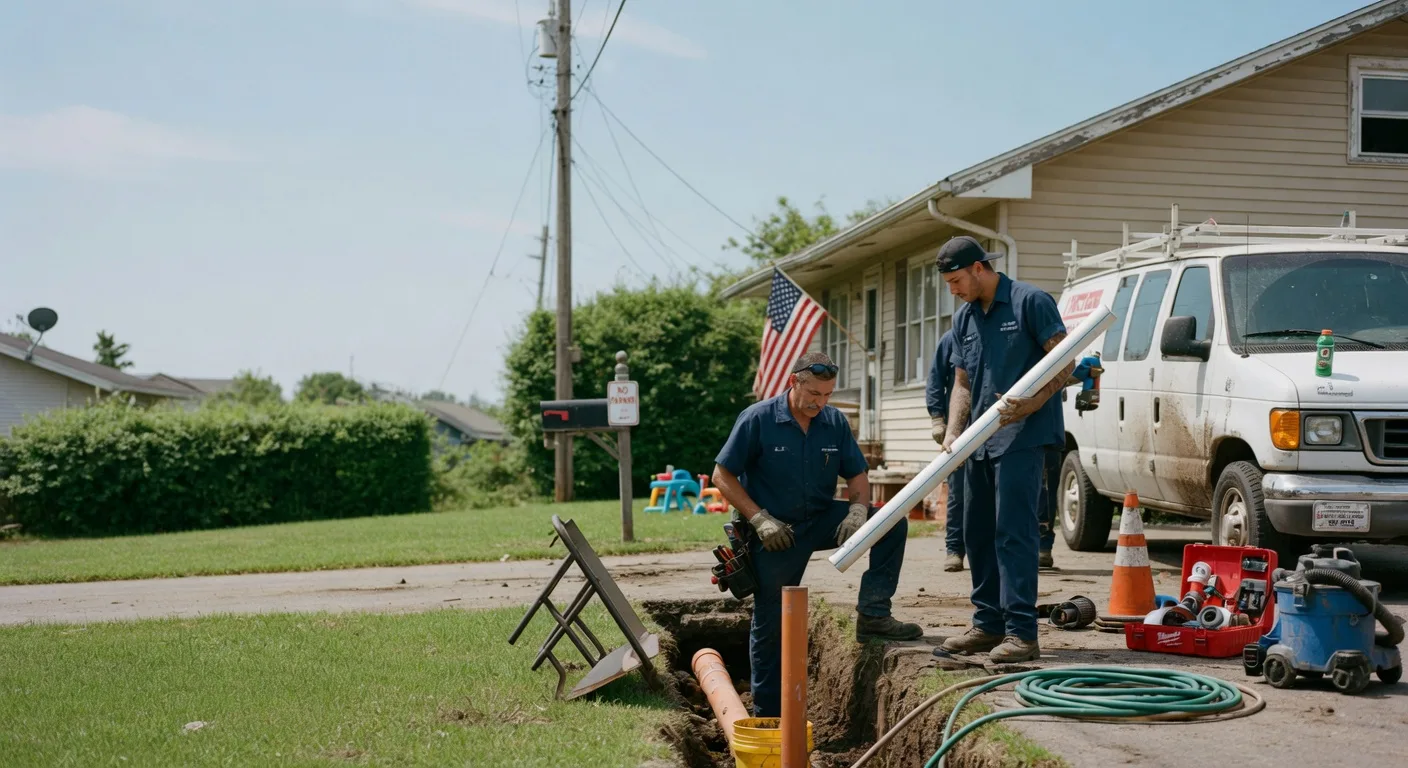
My drains back up every autumn. Why is it seasonal?
That pattern is a clue. Drains that back up every autumn usually have a fixed fault that the season exposes.
Roots chase moisture and grow most actively in the warm months. A clay joint that was passable in spring can be choked by late summer. Then the first heavy autumn rain loads a line that was already marginal, and it backs up.
Leaves are the second cause. Leaves and seed debris wash into a yard drain, a window well or an open cleanout and pack the line. A third cause is a blocked vent stack. Leaves over the roof opening cause gurgling and slow flow without any clog in the pipe.
Safe homeowner check: clear the gutters and the yard drain grate, lift leaves out of the window well, and check that the cleanout cap is seated. Listen for gurgling after a toilet flush.
Stop running water and call now if every drain in the house is slow or backing up, if the lowest tub or floor drain bubbles or fills, or if sewage odor is strong. Those signs point to the main line or a failed sewer lateral. Water used in the house only adds to the backup. Emergency Drain Cleaning calls come from exactly this situation.
A single slow fixture is a cable job. A line that clogs on a schedule is a camera inspection case, because the interval is a symptom of a fixed fault. The camera shows whether it is root intrusion, a bellied section or a damaged joint. Hydro jetting clears the line, and the repair deals with the cause.
Expert Plumbers Co is a referral service. We refer homeowners in Pine Grove, CA to an independent local plumber. Call (380) 262-9173.
Keep a simple log. Note the date, the weather and which fixtures backed up each time. If the dates cluster on rainy days, a storm load or root problem fits. If they follow leaf fall in dry weather, look first at the vent stack and the outside drains. Hand the log to the plumber. It saves a lot of guessing.
If you can plan ahead, book a camera inspection in late summer, when roots are at their thickest and the line is not under storm load. Cutting roots back then, before the rain, is a calmer job than an overnight backup.
Be wary of root-killing foam as a cure. It can slow regrowth, but it does not repair the joint where the roots get in, and they return. Shallow-rooted trees near the lateral, such as willows and maples, are repeat offenders, so mention what grows near the line. Learn where your cleanout is before you need it.
My bathroom sink drains slowly but the stopper is clean. What else could it be?
If you have pulled the stopper and cleaned off the hair and soap film and the sink still drains slowly, the restriction is further down. The stopper mechanism is only the first few inches. Most of the slowdown lives in the pivot rod area, the tailpiece, the trap, or the pipe beyond it.
The common cause is a layer of soap scum, toothpaste and hair that binds together on the pipe wall. It narrows the pipe a little each month, and the sink slows long before it stops.
Safe checks you can do: set a bucket under the sink and unscrew the trap. Clear out what you find and rinse it. Look at the short pipe going into the wall for build-up you can reach with a bottle brush. Fill the basin and let it run, then watch whether the water drains evenly or with a gurgle. Skip chemical cleaners, which can soften plastic fittings and leave caustic liquid sitting in the trap.
Gurgling is a clue. A sink that drains slowly and gurgles can point to a blocked vent, because the drain cannot pull air behind the water. If the toilet or shower near that sink also acts up, the blockage may be in the shared branch line or the main drain, not the sink itself.
One slow sink with everything else normal usually means a local clog, and a cable machine through the trap arm is enough. If the pipe clears and slows again within a few weeks, a camera inspection can show whether the pipe wall is scaled over or has a sag that holds water. Heavy scale or soap buildup in the branch line may call for hydro jetting.
Call and stop using the sink if you see water leaking from the trap or the wall, if sewage smells from the drain, or if several drains in the house slow at once. That pattern usually means the main line is partly blocked.
Cost depends on how easy the pipe is to reach, whether the cleanout is nearby, how far the plumber must run the cable, and whether any worn pipe has to be replaced.
Expert Plumbers Co can connect you with an independent local plumber in Pine Grove, CA when you call (380) 262-9173.
Water or sewage is seeping out around the cleanout cap in my yard. What does that mean?
If liquid is seeping up around the cleanout cap, the sewer line is full to ground level at that point. The cleanout is a capped pipe that gives a plumber direct access to the main line, and it is often the lowest open point on the system. When a blockage sits downstream, waste water rises until it finds the weakest spot, and that is frequently the cap.
Less often the cap itself is the problem: a cracked cap or worn threads can weep a little after heavy use. The difference is the smell and the timing. A damp ring with no odor that dries out is one thing. Grey or dark water with a sewage smell that returns every time the house uses water points to a blocked or partly collapsed line.
Look at the rest of the house. If one fixture is slow, the trouble may be local. If several drains are slow, toilets gurgle, or a floor drain or shower fills when the washer runs, the main line is the likely culprit.
Safe checks you can do:
Keep children and pets away from the wet area. Hold off on laundry, dishwasher cycles and long showers. Do not unscrew the cap. A line under pressure can spray sewage when the cap comes off, and that is a health risk.
Stop running water and call now if sewage is reaching the yard in a steady flow, if it is entering the house, or if the seep keeps growing while you are using as little water as possible.
On the repair side, a cable machine is often enough for a soft blockage such as paper or grease. Roots, heavy grease build-up or scale usually call for hydro jetting or a cutting head. A camera inspection afterwards shows whether the pipe is cracked, bellied or offset at a joint, which decides whether cleaning will hold or whether a repair is needed. Cost depends on how easy the cleanout is to reach, how far the blockage sits from it, how much needs to be dug or removed if a repair follows, and permit requirements under local code.
If the line has to be opened for repair, the local building department may need to be involved. To be connected with an independent local plumber in Pine Grove, CA, call Expert Plumbers Co on (380) 262-9173.
The plumber cleared my line but said the pipe itself has a problem. How do I make sense of the options he lays out?
It is a letdown to pay for a cleared drain and then hear that the pipe is the real trouble. It is also useful information, as long as you understand what you are being offered.
Start by asking what the problem actually is. Common answers include roots entering a clay joint, a bellied section that holds water, a cracked or collapsed pipe, heavy scale in cast iron, or a joint that has pulled apart. Each one has a different fix, and each one has a different level of urgency.
Ask how the plumber knows. The strongest answer is a camera inspection you can watch. If the opinion came from the feel of the cable alone, a camera look is a fair thing to request before spending a lot of money.
Then ask for the options in a clear order, from least to most work.
Keep clearing it on a schedule. This suits roots or grease when the pipe is otherwise sound. It does not fix the pipe, so ask how often it would likely be needed.
Spot repair. A short section is cut out and replaced. This suits one crack or one bad joint, and depends on how deep it is and what has to be dug up.
Trenchless lining or pipe bursting. A new liner or pipe is pulled through the old one with less digging. It depends on the pipe's condition and the line layout.
Full replacement. The failed line is dug up and replaced. This is the most disruptive choice and usually the last resort.
For each, ask what happens if you wait. A small root problem may give you months. A collapse usually does not.
Cost depends on how deep the pipe is, how much has to be opened up, what is above it, such as a driveway or a slab, the materials, and permits under local code. Ask the plumber to put the scope in writing so another plumber can price the same job.
You are allowed to take time and get a second opinion, especially if the pipe is not backing up today.
If you need a drain cleared in Pine Grove, CA, Expert Plumbers Co can connect you with an independent local plumber at (380) 262-9173.
Do enzyme or bacterial drain treatments actually work?
Your drain is slow and the bottle on the shelf says it eats clogs. Does it work? A little, in the right situation, and no for most clogs people buy it for.
Enzyme and bacterial products break down organic film: grease, soap residue, food particles and the slimy layer that builds on the inside of a pipe. They work slowly, over days and repeated doses. Used that way, they help keep a clean line clean.
What they cannot do is just as important. They will not dissolve a hairball in a tub trap, a wad of wipes, a child's toy or a solid plug. They do nothing to tree roots growing into a clay joint. They cannot lift a bellied line that holds water, flatten a collapsed section, or seal a cracked pipe. Scale inside old cast iron is mineral, not organic, so it does not respond either.
If one fixture is slow, the cause is usually local: hair, soap scum or grease in that trap or branch. If every drain in the house is slow, or water backs up in the lowest fixture when you run the washer, the problem is in the main line, and a bottle from the shelf will not reach it.
Safe homeowner check: remove the stopper or strainer and clear what you can by hand. Try a plain plunger. Flush with hot tap water, not boiling, which can soften or damage some pipe and fittings. If you use an enzyme product, follow the label, usually at night when the drain sits unused. Do not mix it with chemical openers.
Stop running water and call now if sewage or gray water comes up in a tub, shower or floor drain, if the toilet and the sink back up together, if gurgling comes from several fixtures.
A cable machine is enough for a single soft clog or a simple plug in one branch. If the line keeps slowing down, a plumber may suggest hydro jetting to clean the full pipe wall, or a camera inspection to see roots, a belly or a damaged joint before anything else is done.
Expert Plumbers Co is a referral service. We connect you with an independent local plumber in Pine Grove, CA. Call (380) 262-9173.
Ask the plumber what they found on the pipe wall, not just whether the water now runs. If it was grease or film, ask whether a maintenance routine makes sense for your line. If it was roots, a belly or damage, ask what repair is involved. The scope depends on access to the pipe, the materials needed, how much has to be opened up, and any permit or code requirement.